



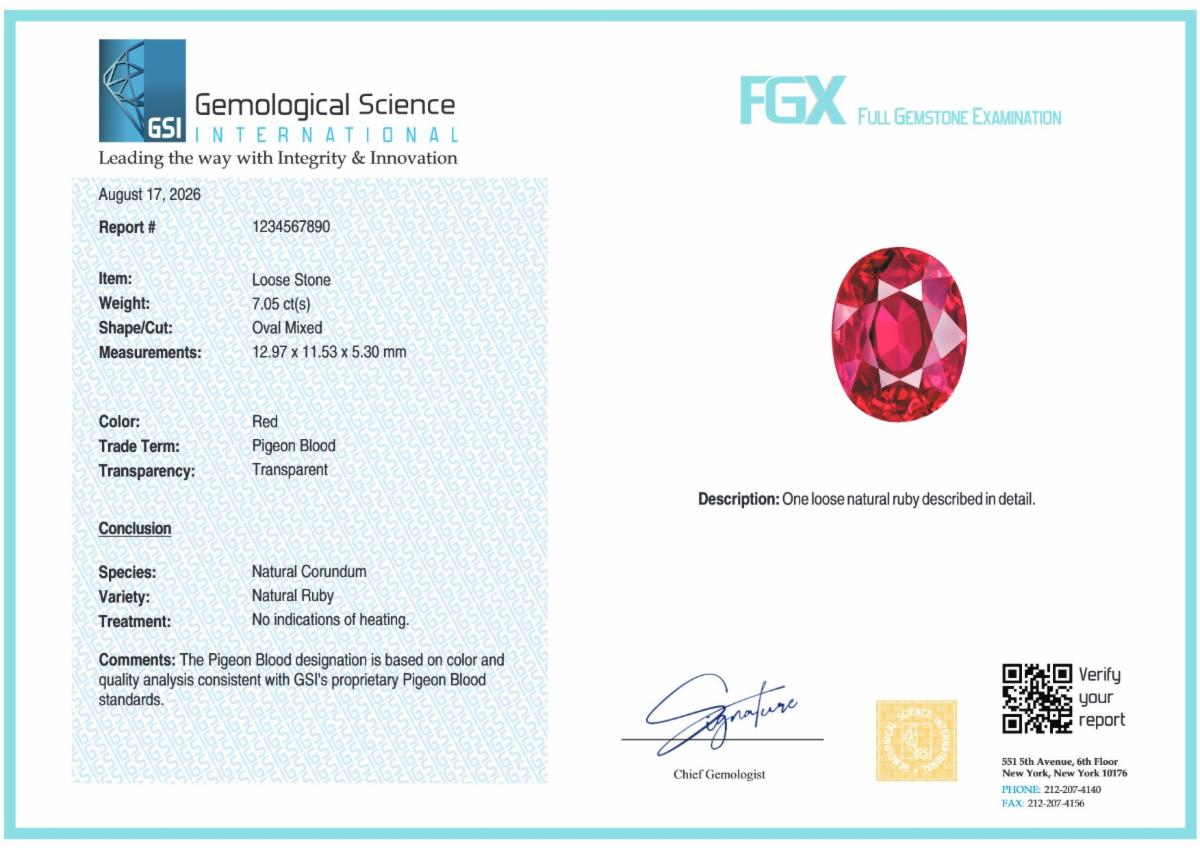

Gemological Science International (GSI) has begun issuing coloured stone reports carrying the trade names Pigeon Blood, Royal Blue and Padparadscha from its laboratories in Jaipur and Mumbai. According to GSI, these are the first reports of their kind to be issued in India.
Limited to Untreated Stones
Under GSI’s criteria, Pigeon Blood applies to qualifying rubies, while Royal Blue and Padparadscha apply to qualifying sapphires. The designations are available only for untreated stones, with heated, diffused or otherwise enhanced material excluded irrespective of its colour.
GSI said its assessments use defined ranges of hue, tone and saturation. Stones are examined under standardised lighting, supported by spectroscopic and colorimetric analysis.
The laboratory group said the same criteria apply across its issuing locations through shared master reference sets, calibrated instruments and proficiency testing.
Domestic Testing for the Indian Trade
The service allows manufacturers and dealers in India to submit qualifying stones for assessment without sending them to laboratories overseas. This could reduce transport costs, turnaround times and the risks associated with shipping high-value gemstones internationally.
It also gives businesses in Jaipur, one of India’s main coloured gemstone cutting and trading centres, domestic access to these reports.
“A stone finished here has always had to travel abroad to carry a name like Pigeon Blood. That ends today,” said Meenu Brijesh Vyas, global head gemologist at GSI.
Laboratory Criteria Remain Relevant
Pigeon Blood and Royal Blue are established commercial descriptions but are not governed by a single international standard. Laboratories may apply different eligibility requirements, including rules covering treatment, fluorescence, transparency and colour.
The Swiss Gemmological Institute SSEF notes that laboratories assess stones using their own protocols and master sets because no international standard has been established for the terms.SSEF
For jewellers, the laboratory named on a report and the criteria it applies therefore remain relevant when describing or comparing stones. CIBJO has previously cautioned that consumers may interpret these descriptions as universal industry standards or quality grades, although requirements can differ between laboratories.CIBJO
GSI’s trade-name reporting service is available in Jaipur, Mumbai, New York and Bangkok.
